
ILAB Comply Chain Website Redesign
Delivering a ground-up, accessibility-first digital product under a fixed 120-day federal deadline.
Overview
The ILAB Comply Chain Website Redesign was a full rebuild of an outdated, text-heavy digital product serving a global audience navigating complex labor compliance information.
Although framed as a redesign, the project required rebuilding the site from the ground up. Existing templates, content structures, and interaction patterns were no longer viable. The work encompassed information architecture, content strategy, accessibility governance, and system-level UX decisions needed to support clarity, performance, and long-term maintainability.
As one of the Department of Labor’s first in-house UX SMEs, and the first to embed with ILAB, I led UX strategy and execution across the full lifecycle, delivering a responsive, Section 508–compliant digital product that significantly improved task clarity, engagement, and performance under real-world connectivity constraints.

My Role
I served as the UX Lead, embedding directly with ILAB stakeholders and external vendors across the full design and delivery lifecycle.
My responsibilities included:
Leading UX strategy, accessibility governance, and design quality assurance
Guiding an external vendor through federal accessibility and compliance standards
Conducting heuristic reviews and identifying critical usability and accessibility risks
Defining scalable UX frameworks adopted across additional DOL projects
Translating policy and compliance requirements into actionable design guidance
This was the first DOL OCIO/ILAB collaboration to embed a UX SME end-to-end. My role was not advisory or downstream, but central to shaping how the product was structured, built, and validated.
Context
The Comply Chain website was highly visible, globally accessed, and operationally critical, yet constrained by legacy content structures and outdated design patterns.
Key constraints shaping the work:
Fixed 120-day delivery timeline
High-visibility public relaunch
Global user base with varied access and abilities
First ILAB project to embed UX across strategy, design, and delivery
ILAB needed to relaunch the site within a non-negotiable 120-day window, while ensuring accessibility compliance, content clarity, and performance for users with limited or unstable internet access. The audience included international stakeholders navigating complex compliance information, often under time and connectivity constraints.
The work required balancing speed with rigor, coordinating across internal teams and vendors, and establishing UX standards where none had previously existed within ILAB.
Strategy
The strategy prioritized accessibility, clarity, and system integrity before visual polish.
Rather than treating accessibility and compliance as downstream checks, I embedded them as first-order design inputs. This meant establishing clear standards early, aligning stakeholders around usability and accessibility principles, and guiding vendor execution toward compliant, user-centered solutions.
Key strategic moves included:
Defining accessibility and usability standards before design execution
Identifying and correcting usability risks through heuristic review
Reframing navigation and content structure around user mental models
Establishing repeatable UX and accessibility frameworks for future projects
The goal was not just to ship a compliant site, but to raise the quality bar for how ILAB and DOL approached digital product design.
Strategy succeeded when vendors, stakeholders, and reviewers shared a common understanding of what “good” looked like, and how to achieve it under constraint.
Governance Snapshot
The artifacts below illustrate how accessibility, usability, and compliance were translated into concrete, reviewable design decisions.
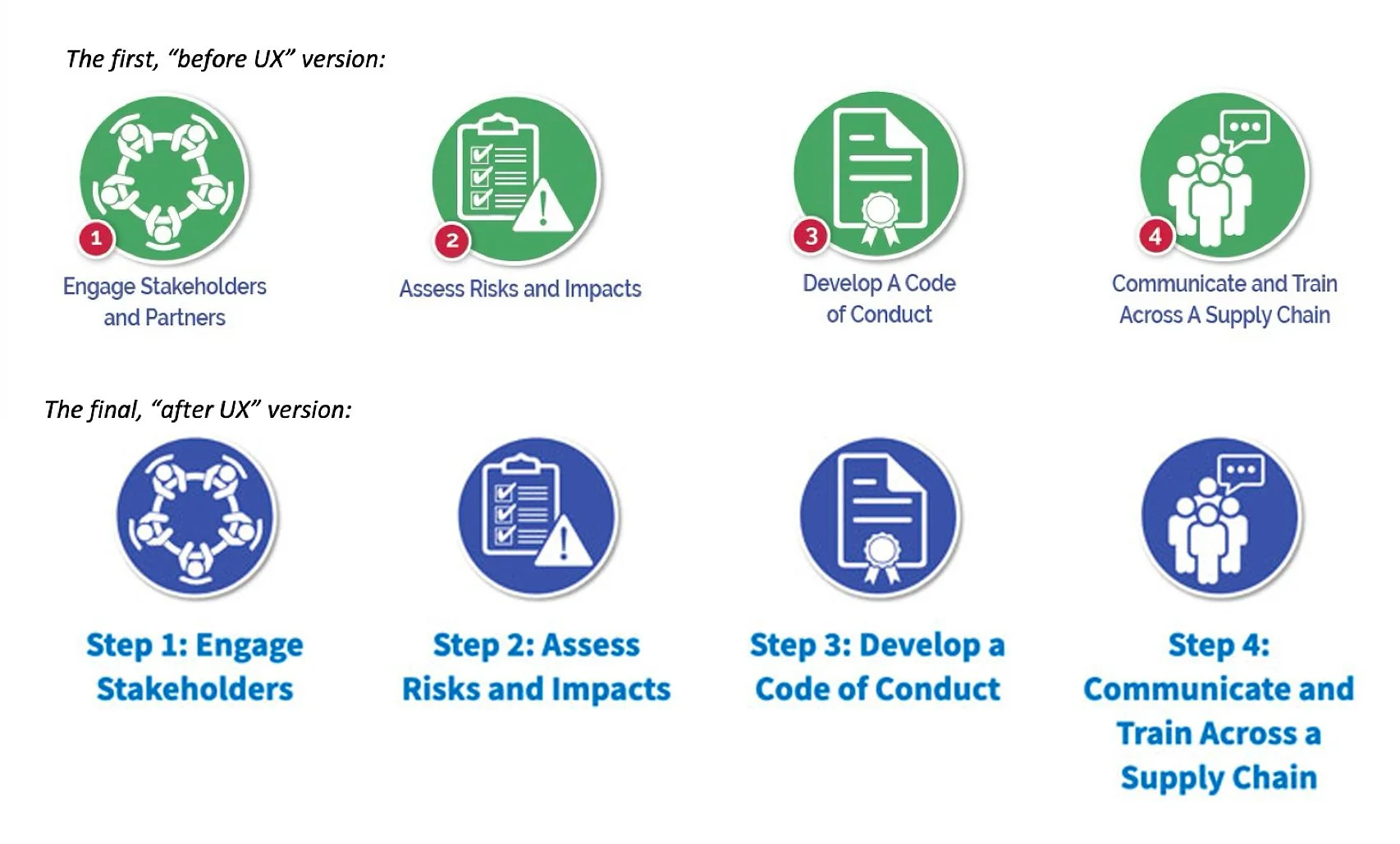
This work focused on making design decisions visible, defensible, and actionable:
Identifying accessibility and usability risks early.
Establishing clear design standards and acceptance criteria.
Guiding vendor iteration toward compliant, user-aligned solutions.
Ensuring final outputs met federal accessibility requirements.
Design Problem → Solution Example.
Initial icon designs introduced usability and accessibility issues that had been tentatively approved by stakeholders. Through heuristic review, I identified the risks, defined corrective standards, and guided the vendor to a compliant solution aligned with user mental models and the evolving design system.
Outcomes
+30% increase in user engagement post-launch
Delivered a responsive, Section 508–compliant digital product within 120 days
Improved page load performance for users with limited connectivity
Established UX frameworks adopted across additional DOL initiatives
Invited to present methodology and impact at a Drupal4Gov webinar
While the site redesign delivered immediate user impact, the longer-term value was structural. This work helped establish UX, accessibility, and governance standards that extended beyond a single product.
What This Work Demonstrates
This case reflects how I lead ground-up digital product delivery under extreme time and compliance constraints.
The Comply Chain project demonstrates how UX leadership can function as both a delivery accelerator and a quality safeguard, embedding accessibility, content strategy, and system thinking into fast-moving, high-visibility work.
Although delivered in a federal context, the challenges addressed here—legacy systems, accessibility requirements, vendor coordination, and global usability—closely mirror those faced by enterprise and regulated organizations rebuilding critical digital products from scratch.