
Designing Human-in-the-Loop AI Systems for Anti-Financial Crime
Applying systems strategy, workflow architecture, and governance-aware operational design to support enterprise AI adoption in a regulated Anti-Financial Crime environment.
Overview
An enterprise AI initiative within a highly regulated Anti-Financial Crime (AFC) environment was being actively developed to support workflows such as regulatory analysis, policy review, and compliance documentation support.
As I analyzed the system’s workflows and rollout model, I identified a growing gap between technical capability and operational usability.
While the underlying AI platform functioned technically, it lacked the workflow structure, governance visibility, continuity controls, and operational support required for scalable enterprise adoption.
As the initiative matured, many of these concerns would later emerge during rollout, reinforcing a key finding of the project: successful AI adoption depends as much on operational design and workflow integration as it does on model capability.
What began as workflow analysis evolved into a broader systems initiative focused on operationalizing enterprise AI adoption through:
Structured workflow architecture.
Governance-aware interaction design.
Operational enablement strategy.
Continuity and escalation modeling.
Enterprise integration concepts.
The result was a systems-level framework, designed to help transform a transient AI chat tool into a more governable and operationally resilient enterprise environment.
Impact At-A-Glance
✓ Created a governance-aware AI operational framework
✓ Designed a structured analyst-focused agent workspace
✓ Mapped workflow architecture for regulated AFC tasks
✓ Devised an adoption and operationalization strategy
✓ Integrated Agentic AI governance and escalation reporting
Context
The Problem Space
The division utilized an AI agent intended to support high-stakes workflows including:
Regulatory monitoring
Policy analysis
Multi-document comparison
Gap analysis
Compliance documentation support
While technically functional, the system introduced several emerging operational risks during active development.
All workflows were handled through a single generalized conversational interface, while governance visibility, continuity behavior, escalation pathways, and operational transparency remained limited.
Most critically, the system treated operational compliance work as transient conversation rather than structured enterprise workflow.
This introduced growing operational risks around:
Workflow ambiguity
Validation behavior
Continuity
Operational trust
Long-term scalability
The challenge was no longer purely technical. It had become operational, requiring the alignment of workflows, governance, user behavior, and organizational adoption.
The core problem was not whether the AI system technically worked.
The problem was whether enterprise users could reliably operationalize it inside real compliance workflows.
Service Strategy
One Front Door, Differentiated Workflows
One of the most significant operational risks was treating all AFC workflows through a single generalized conversational interface.
Different operational tasks carried different:
validation requirements
source expectations
escalation thresholds
reasoning patterns
risk tolerances
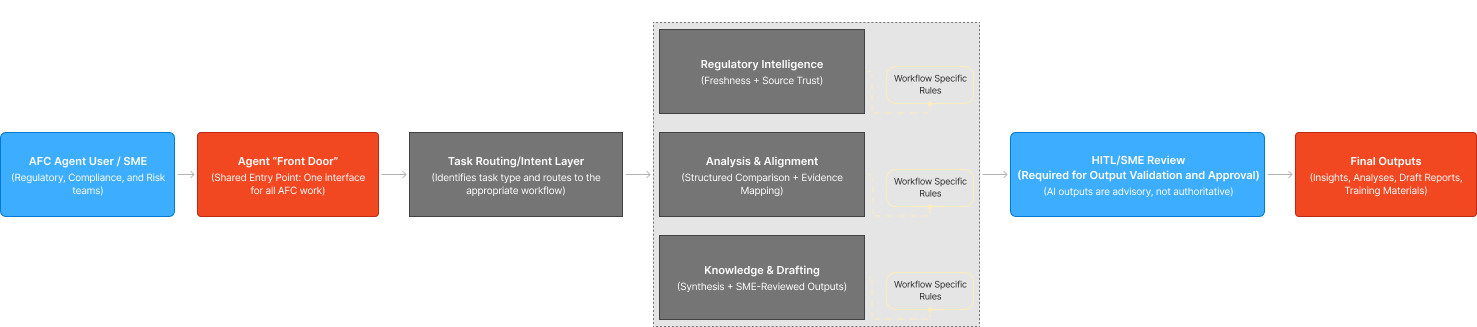
To address this, I developed a lightweight workflow architecture model built around a unified entry point with differentiated operational pathways:
Regulatory Intelligence
Focused on regulatory monitoring and emerging guidance analysis.
Analysis & Alignment
Focused on policy analysis, multi-document comparison, and gap detection workflows.
Knowledge & Drafting
Focused on internal documentation support and structured synthesis tasks.
This structure preserved a unified user experience while introducing clearer workflow boundaries and more defensible operational behavior.
The enterprise integration strategy was designed to support:
Governance separation
Operational continuity
Enterprise support integration
Secure access control
Future scalability
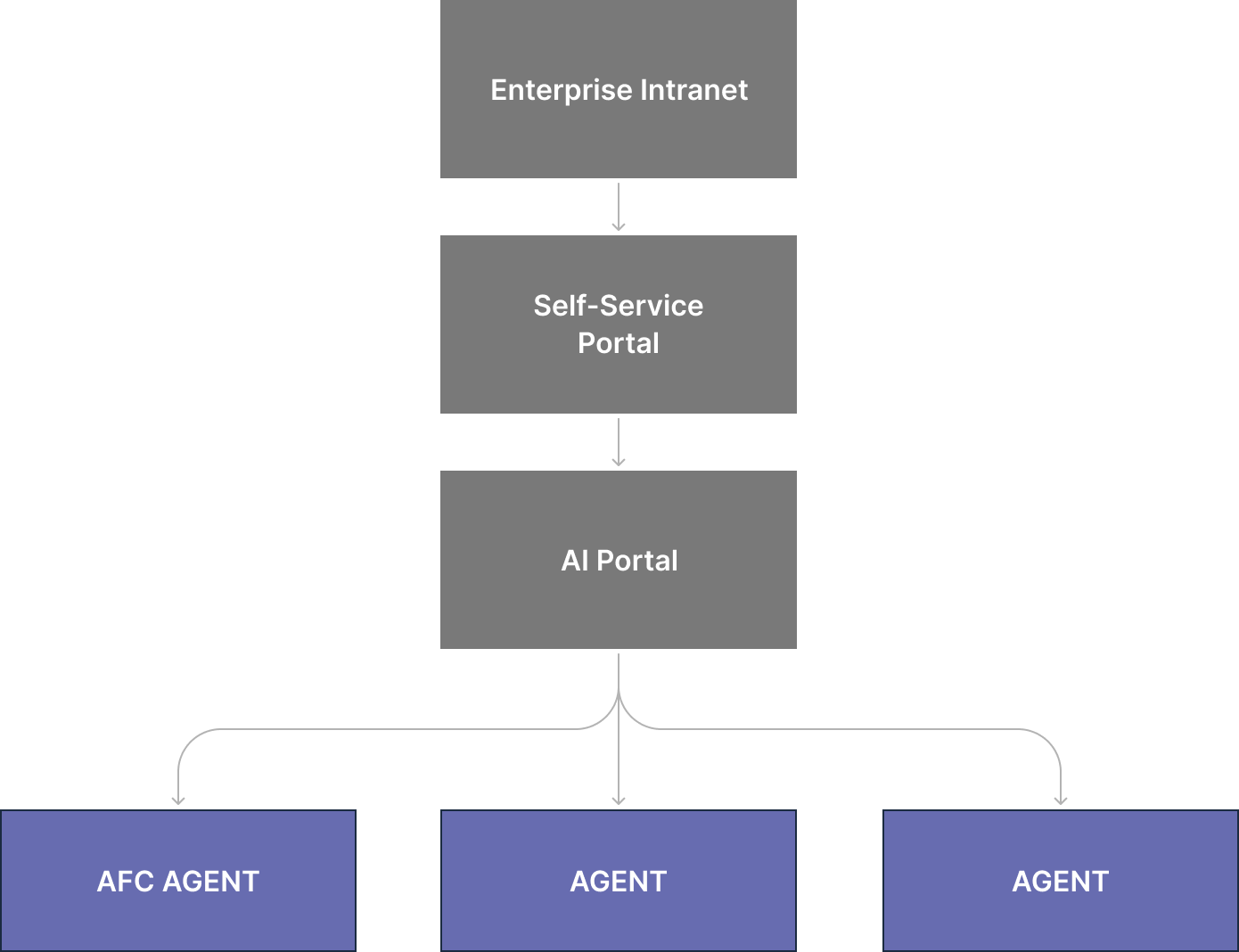
Enterprise AI Agent Access Model
Flow documenting the integration of AI tools within the enterprise and the secure access pathways.
My Role
Lead Product & Service Design
Systems Strategy · Operational UX · Workflow Architecture · Interaction Design
I Independently:
Identified operational adoption risks
Mapped workflow and continuity gaps
Developed governance-aware workflow concepts
Designed the interaction architecture
Created high-fidelity prototypes
Produced rollout and operational maturity recommendations
Validated concepts with project stakeholders and power users
This work was developed alongside an active enterprise AI initiative, operating under real organizational, security, and regulatory constraints.
Core Areas
Enterprise AI Operationalization
Governance-Aware UX
Workflow Architecture
Human-in-the-Loop Systems
Cross-Functional Translation
SYSTEM Snapshot
A high-level view of how the system operates across structured workflows, validation layers, and governance checkpoints.
The models below translate regulatory expectations into enforceable system behavior.
System Overview: End-to-End Workflow
End-to-end workflow: how AFC tasks move through structured, governed workflows–from intake to validated output.
SELECT SYSTEM COMPONENTS
Verification + Cross Check
Detects system drift, degraded performance, and inconsistencies over time. Cross-references outputs against multiple signals to ensure accuracy and reliability.
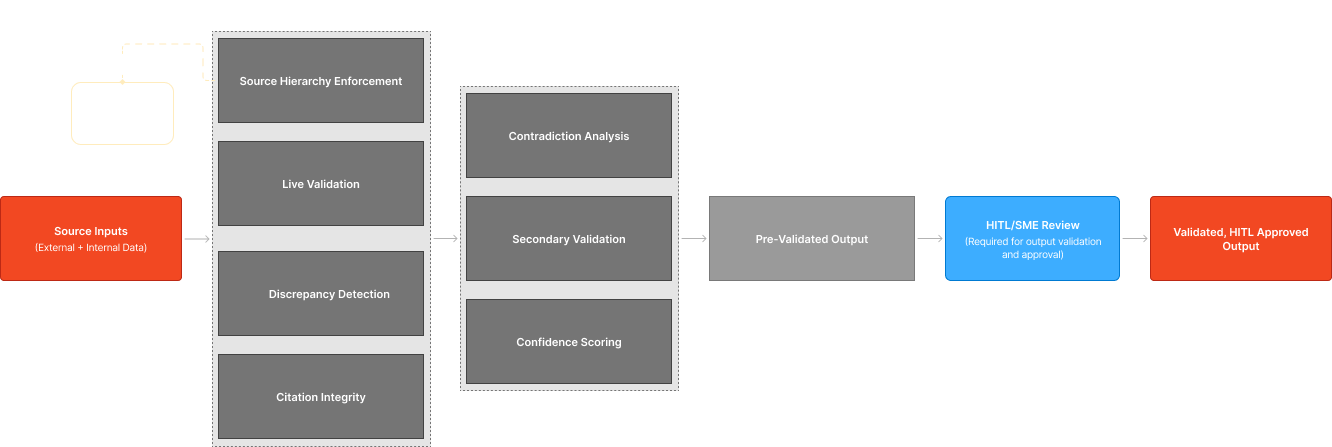
HITL Governance Model
Embeds human review as a required system function, ensuring outputs are validated, contextualized, and approved before use.
Risk Degradation + Monitoring
Continuously monitors system behavior over time, identifying emerging risks and triggering intervention before failures escalate.

Core Use Case
Governance-aware, End-User-Focused Prototype
Traditional conversational AI interfaces are optimized for short, transient interactions. This environment required something different: support for longer-running investigations, workflow continuity, governance visibility, reference validation, and structured task execution within a regulated environment.
To address these needs, I designed a structured tri-pane analyst workspace centered on operational usability rather than dashboard-heavy analytics patterns. The experience combined guided workflow entry, validated resources and references, governance visibility, outputs and uploads management, and task-oriented interaction patterns that reinforced continuity, traceability, and evidence-backed decision making.
UX Research-Informed UI Design
Feedback from the initiative's primary stakeholder and power user reinforced the value of a governance-aware, workflow-oriented experience.
While the production environment centered on a generalized conversational interface, the proposed workspace concepts provided clearer task initiation, workflow continuity, operational transparency, and user support, capabilities viewed as critical for broader organizational adoption.
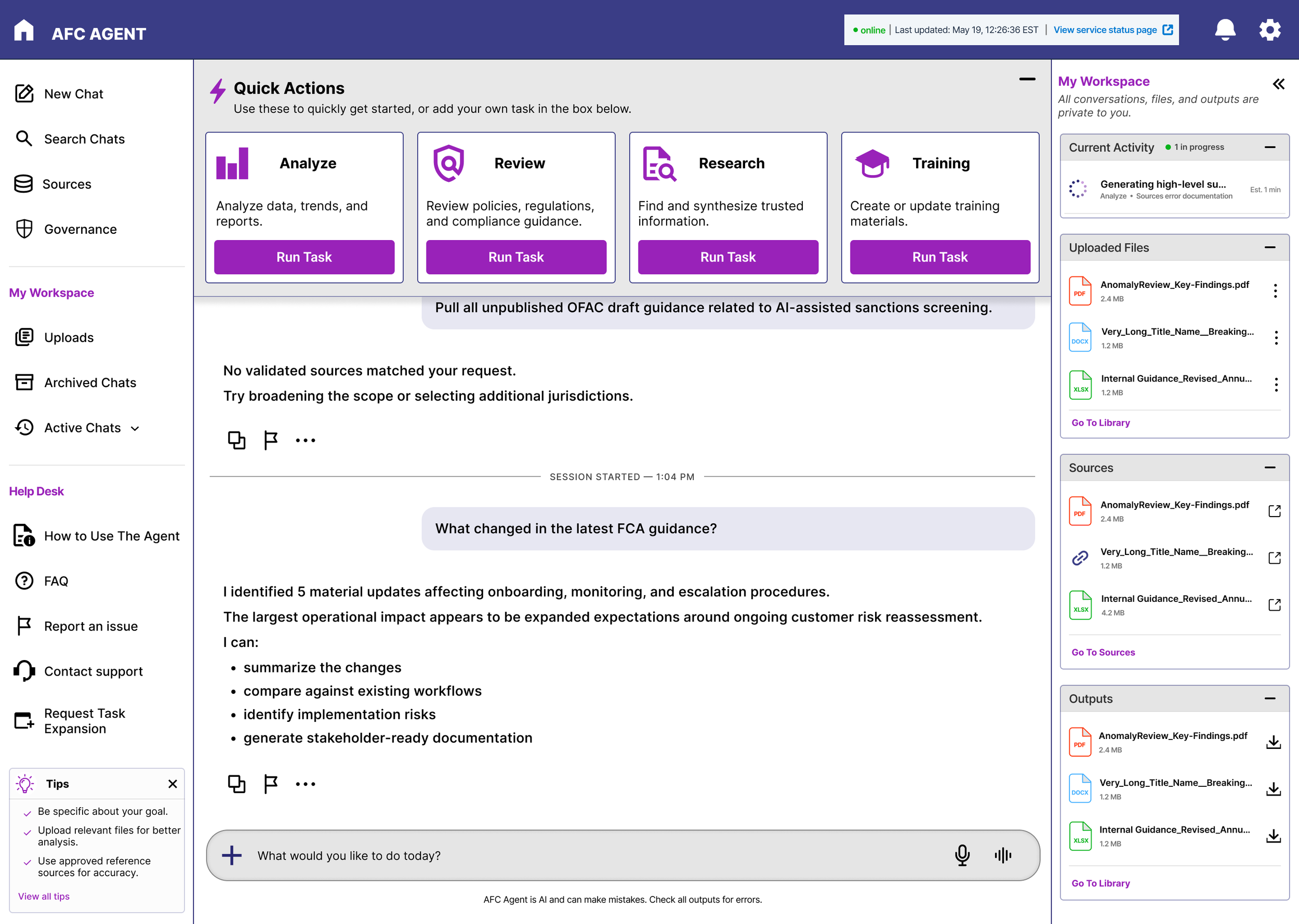
AFC AI Agent tri-pane prototype and the annotated version for engineering.OPERATIONALIZATION & ADOPTION
Adoption & Enablement Strategy
Beyond the interface itself, I developed a lightweight operational enablement framework designed to support adoption, workflow consistency, governance visibility, and long-term scalability.
The framework focused on helping users understand how the system fit within existing operational processes, reinforcing evidence-backed decision making and human accountability, and treating workflow friction, overrides, and user behavior as signals for ongoing improvement.
This shifted the initiative from AI deployment into operational AI adoption.
Designing Beyond Initial Rollout
In addition to the core experience, I explored forward-looking concepts intended to support enterprise maturity over time, including:
Session continuity
Structured archives
Operational traceability
Service transparency
Escalation pathways, and
User-controlled resources
Several concepts were specifically designed to reduce adoption friction, support less-experienced users, and minimize the operational burden placed on subject matter experts as usage scaled.
OUTCOME
The project produced governance-aware workflow frameworks, systems architecture concepts, structured interaction models, high-fidelity prototypes, and operational maturity recommendations intended to support the responsible adoption of AI within a regulated environment.
More importantly, the work helped shift the conversation beyond model capability and toward the broader operational factors that determine long-term success, including workflow continuity, governance visibility, escalation pathways, organizational trust, and enterprise scalability.
Enterprise AI systems succeed or fail less because of model capability alone, and more because of how effectively they integrate into real operational workflows.
Operational Validation
Several months after the recommendations were delivered, rollout observations provided an opportunity to evaluate many of the risks identified during workflow analysis and systems design.
While the underlying AI platform continued to evolve, user feedback and production observations reinforced a consistent pattern: the most significant challenges were not technical capability issues, but operational ones.
Challenges emerged around workflow continuity, governance visibility, session persistence, operational transparency, and user confidence. Subject matter experts spent valuable time troubleshooting routine tasks, while system behavior became increasingly difficult for users to interpret, validate, and trust.
These observations reinforced the central finding of the project: successful enterprise AI adoption depends on far more than the model itself. Long-term success requires workflows, interfaces, governance structures, and operational support systems that help users confidently integrate new technology into their daily work.
Many of the operational challenges observed after rollout reflected workflow, governance, and adoption risks identified during earlier discovery and systems design.
What This APPROACH Demonstrates
Systems-Level Product Thinking
Identifying operational and organizational risks before they become larger workflow, adoption, or governance challenges.
Workflow Architecture
Structuring AI interactions around real operational tasks and user needs rather than generalized conversational behavior.
Enterprise AI Operationalization
Understanding that successful AI adoption depends on more than model capability. Workflow design, governance, operational readiness, and user trust ultimately determine long-term outcomes.
Strategic + Hands-On Execution
Moving fluidly between systems strategy, operational reasoning, interaction design, and high-fidelity prototyping.
Governance-Aware UX
Designing workflows that support accountability, validation, escalation pathways, and evidence-backed decision making.
Cross-Functional Translation
Bridging gaps between technical systems, governance requirements, stakeholder priorities, and end-user operational realities.